Client money, broker failure and compensation: what segregation does and does not protect
Segregation rules aim to keep client money separate from a broker's own funds so it can be returned or transferred if the firm fails. Compensation schemes may cover an eligible shortfall afterwards. Neither makes cash instantly available during administration, neither covers ordinary trading losses, and outcomes depend on reconciled records, eligibility and the exact legal entity you contracted with.
Two different mechanisms sit behind the phrase "your money is safe" when a broker fails. The first is client-money segregation: regulatory rules that require a firm to hold client money separately from its own money so it can be identified and returned if the firm exits the market. The second is investor compensation: a scheme that may pay eligible people for losses caused by a firm's failure. Neither mechanism puts cash back in your account the day administration starts, and neither compensates ordinary trading losses. This guide explains how each layer works, what happens during a failure, and which documents prove your entitlement before anything goes wrong. [1] [2] [5]
Segregation and compensation are not the same promise
Segregation is preventive. Under the UK Client Assets Sourcebook (CASS), firms that hold or control client money must place received client money promptly into specified types of client account and maintain adequate arrangements to safeguard client rights, prevent use of client money for the firm's own account, and minimise loss from misuse, fraud, poor administration, inadequate record-keeping or negligence. Segregation reduces the risk that client money is lost inside the firm's estate, but the rules themselves acknowledge it is not a guarantee against shortfall, delay, bank failure, dispute or cost. [1] [2]
Compensation is reactive. A scheme such as the UK Financial Services Compensation Scheme (FSCS) may pay up to £85,000 per eligible person, per firm, for a valid investment claim against a firm that failed after 1 April 2019. Eligibility depends on the provider being appropriately authorised, the service and product being regulated, and legal liability resting with the failed firm. In a failure, compensation may address an eligible loss that the firm cannot meet; it is not a routine top-up on every balance. [5]
The practical consequence is that access to a balance may be restricted while records are reconciled, even where the client-money pool was kept separate. Open positions are a different question from client cash, and their treatment must be checked against the contract and the applicable insolvency process. [3]
The balances you should be able to identify before a failure
Broker platforms display one number, but several distinct records sit behind it. Knowing which is which matters because administrators, distribution rules and compensation schemes treat them differently.
- Cash balance: cleared funds held in your account, which may be client money held in a pooled statutory trust account rather than a named individual account. [2]
- Open-position market value or unrealised profit and loss: a valuation of positions you hold, not cash, and subject to change until positions are closed or settled.
- Realised but unsettled transactions: profits or proceeds from closed trades that have not yet completed settlement.
- Pending deposits and withdrawals: money in transit whose status depends on whether the payment was completed and how it appears in the bank and broker records.
- Custody assets: securities or other assets held for you, distinct from client money and governed by separate custody rules. [1]
- Client money versus broker-owned money: only the former falls within the client pool; the latter belongs to the firm's estate. [2]
- The contracting legal entity: the company named in your account agreement, which is central to identifying the regulator, permissions and possible compensation scheme, alongside product and eligibility rules. [6]
Why a brand is not a protection regime
A brokerage group may operate multiple legal entities under different regulators, permissions and arrangements, while presenting them under one brand. The entity that signed your agreement is the starting point for checking protection; the logo is not. [6]
The FCA's Firm Checker and Financial Services Register are the official tools for checking authorisation, permissions and history, including whether a firm can handle client money. Matching the exact legal entity, website address and contact details against the register helps identify clone firms. If your account agreement names one entity, your statements show another, and payments go to a third set of details, treat that inconsistency as a problem to resolve before funding further. [6]
What CASS safeguards actually require of a UK broker
Firms holding or controlling client money or custody assets must follow the Client Assets Sourcebook. CASS 7 requires adequate arrangements to safeguard client rights and minimise loss from misuse, fraud, poor administration, inadequate record-keeping or negligence. Received client money must be placed promptly into specified types of client account, subject to the chapter's details and exceptions. Records and regular reconciliation are central to the regime. [1] [2]
Medium and large CASS firms face additional obligations, including a monthly Client Money and Asset Return and senior-responsibility requirements. Firms in scope of CASS 6 or CASS 7 must also maintain a CASS resolution pack containing documents such as recent reconciliations and custodian lists, designed to help an insolvency practitioner return client assets more quickly. The pack facilitates return; it does not insure balances or guarantee timing. [1] [4]
One common misunderstanding deserves correction: an FCA licence does not mean every pound you deposit sits in a separate bank account bearing your own name. The CASS framework permits client money to be pooled in client accounts, with internal records tracking each client's entitlement. Compliance still depends on the firm's actual arrangements and records. In a failure, the reconciled pool and entitlement matter rather than a personal ring-fenced pot. [2]
The failure sequence, step by step
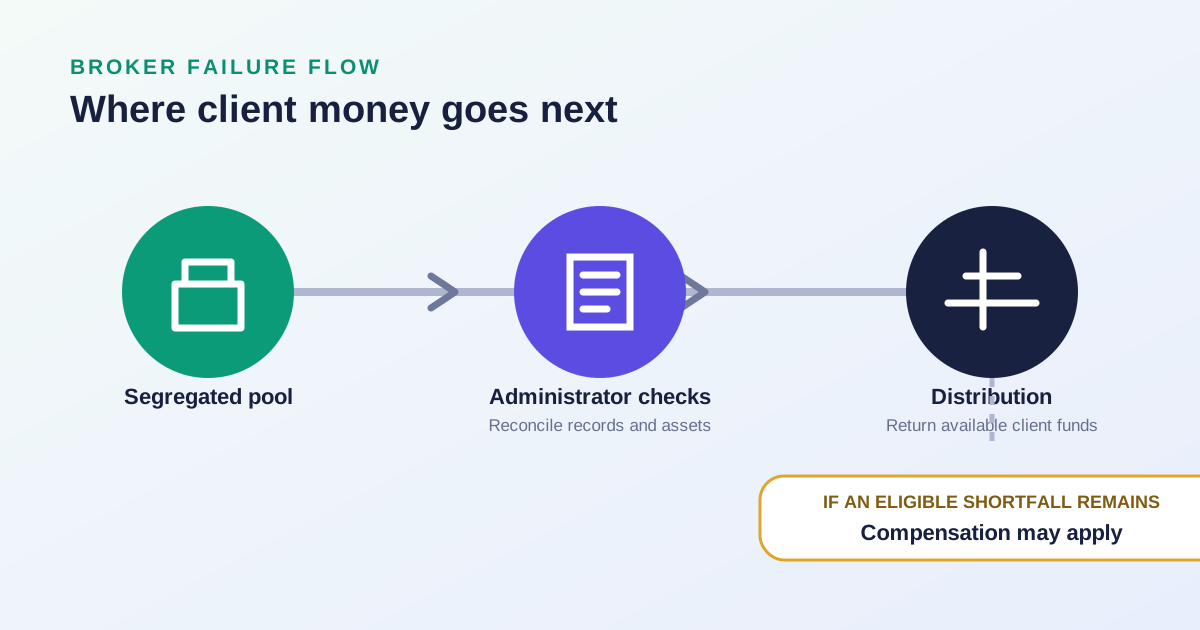
Insolvency processes vary by jurisdiction and case, but the broad sequence below is a useful map of the cited UK client-money process. Timing depends on the facts of the administration and is not predicted here. [3] [4]
- Trading or withdrawals may be restricted while the appointed administrator establishes control and works out how the relevant assets and claims will be handled. [3]
- An administrator identifies the estate and the client pools, distinguishing client money and custody assets from the firm's own assets using the resolution pack, books and bank and custodian records. [4]
- Records are reconciled. Internal ledgers are checked against bank statements and custodian confirmations to establish each client's recognised entitlement. [3] [4]
- Claims or transfer instructions may be requested. Follow the appointed administrator's published process, including any request to confirm details or submit a claim. [3]
- Client money is returned or transferred, either paid out or moved to a successor firm where the rules facilitate return or transfer following a pooling event. [3]
- Any shortfall, dispute or distribution cost is dealt with under the applicable regime. Where a qualifying shortfall arises, CASS 7A provides for rateable sharing within the relevant pool, and eligible clients may pursue compensation separately. The Beaufort case shows that distribution costs can also affect outcomes. [3] [5] [9]
Secondary failure: when the bank or custodian holding the pool fails
Segregation aims to distinguish client money from the broker's own estate, but the pooled account still sits somewhere. If the bank, custodian or third party holding the pool fails, clients can still face loss even where the broker followed its segregation process. CASS 7A contains secondary-pooling mechanics that allocate certain losses among clients where a person holding the firm's client money fails. The cited rules do not establish that the broker must make every such shortfall whole. [2] [3]
Open leveraged positions are not idle cash
Unrealised profit and loss is a valuation, not a balance you can withdraw. The sources in this guide do not establish one outcome, valuation time or close-out price for open positions after a broker failure. Contract terms and the applicable insolvency process determine how positions are handled. Retain the product terms you agreed to, timestamped statements showing position sizes and entry levels, and trade confirmations so that a later valuation question can be tested against records rather than memory.
How shortfalls work: a labelled hypothetical
The following arithmetic is illustrative only. It shows how rateable allocation works; real pools, claims, costs and scheme coverage can differ substantially. [3]
- Suppose the reconciled client-money entitlement across a pool is £10 million, but only £9.6 million is available before applicable costs. The shortfall is £400,000, or 4% of the entitlement.
- If the same rateable allocation applied, a customer with a £20,000 recognised share would receive £19,200 before any separate eligible compensation.
- Whether that customer could then claim the remaining £800 from a compensation scheme depends entirely on eligibility, the relevant firm, the regulated activity and legal liability under that scheme's rules. [5]
Distribution costs themselves can reduce recoveries. In the Beaufort Securities case discussed below, some ineligible or above-limit clients bore costs or shortfalls even though most client money was eventually returned. [9]
Four concepts traders routinely conflate
Segregation, insolvency distribution, investor compensation and deposit insurance answer different questions about different risks. Confusing them leads to false confidence before a failure and misplaced claims afterwards.
UK FSCS investment protection in scope
For a firm that failed after 1 April 2019, FSCS may pay up to £85,000 per eligible person, per firm, for a valid investment claim. The provider or adviser must have been appropriately FCA or PRA authorised, the service and product must have been regulated, and legal liability must rest with the failed firm. FSCS does not compensate pure poor investment performance. Not every FCA-regulated broker failure produces an £85,000 payout; eligibility, the relevant firm and the nature of the loss all matter. [5]
EU minimums and the Australian framework
These frameworks differ in type, and comparing them is not a ranking or a substitute for checking the rules that apply to your specific account.
EU countries must have investor-compensation schemes providing at least €20,000 per investor where an investment firm cannot return assets. The directive addresses failure to return assets, often linked to fraud, administrative malpractice or operational error, and does not cover investment losses from falling market value. National scheme rules and eligibility control, so coverage is not identical across every European broker account. [7]
The cited ASIC source describes conduct, record and reconciliation requirements rather than an investor-compensation figure. AFS licensees holding reportable derivative retail client money must keep accurate per-client and aggregate records, perform reconciliations and meet reporting rules under the ASIC Client Money Reporting Rules 2017. A client-money account is generally operated as a trust account, with funds held on trust for entitled persons. The scope excludes derivative money held for derivatives traded on domestic exchanges. Trust-account status does not remove every insolvency risk, and this guide makes no claim about an Australian compensation limit. [8]
Case study: Beaufort Securities and Beaufort Asset Clearing Services
The FCA's completed case update on Beaufort Securities Limited and Beaufort Asset Clearing Services Limited reports that 99.7% of client money and 99% of client assets, excluding compliance-related balances, had been returned. It also confirms that distribution costs and shortfalls existed, that FSCS eligibility mattered, and that some ineligible or above-limit clients bore costs or shortfalls. [9]
The FSCS limit relevant to that failure date was £50,000. That figure applied to the Beaufort case specifically and must not be mixed with the £85,000 UK investment-claim limit shown by FSCS when this guide was checked. The case shows that reconciliation, distribution costs and eligibility boundaries can affect recovery. It does not imply the next failure will follow the same path or produce the same percentages. [9] [5]
Before-funding checklist: pin down the exact legal entity
Complete this checklist from official records before funding an account. Each item should be verifiable independently of the broker's marketing materials. [6]
- Record the exact legal entity and company number named in the account agreement, not just the brand. [6]
- Identify the regulator and licence number, and locate the official register entry URL. [6]
- Confirm the register shows permission to hold client money for the activities you will use. [6]
- Note the account jurisdiction and your client classification, since both affect applicable rules and eligibility.
- Identify the compensation scheme covering the entity and save the eligibility link from the scheme's official site. [5] [7]
- Save the client-money disclosure from the terms, including how funds are held and pooled. [2]
- Where provided, record bank and custodian disclosures naming where client money is held. [4]
- Note the title of the bank account receiving your deposits and check it matches disclosed client-account arrangements. [2]
- Store the account agreement version and date you accepted it.
- Record the complaints contact and run a small withdrawal test, saving evidence of how long it took and which bank details were used.
Document pack checklist: what to keep and how
A clear evidence pack helps establish and check your claimed entitlement. Build it continuously rather than reconstructing it under pressure.
- Signed terms and the onboarding email confirming the legal entity you contracted with. [6]
- Monthly statements, plus daily screenshots of your account when risk rises, noting timestamps.
- Deposit receipts, bank statements showing transfers to the disclosed client account, and withdrawal requests with their outcomes.
- Trade confirmations, tax reports and support correspondence relating to disputes or unusual activity.
- Any complaint reference issued by the broker or regulator, and identity and address evidence matching your account records.
Keep copies offline and encrypted where appropriate. Never publish credentials, full account numbers or identity documents in forums or support channels, and never store unencrypted passwords alongside trading records.
After a failure: practical steps without legal advice
This is procedural guidance, not legal advice. For material or disputed claims, obtain professional advice from a qualified adviser or solicitor.
- Stop sending funds immediately, including pending scheduled deposits.
- Capture records: export statements, screenshot balances and positions with timestamps, and preserve correspondence.
- Use regulator and administrator notices as your primary information source, and verify domains and bank details through official channels before acting on any instruction. [6]
- Submit claims by the published methods and deadlines, and preserve every acknowledgement. [3]
- Treat unsolicited recovery offers, changed bank details and requests for credentials as unverified. Confirm the administrator, scheme and contact channel against an official regulator notice before responding.
Common false assumptions that cost traders money
- False assumption: regulated means risk-free. Registration confirms authorisation and permissions; it is not proof of solvency or perfect records. [1] [6]
- False assumption: segregated means instantly withdrawable. A failure process may restrict access while pools are reconciled. [3]
- False assumption: the broker brand equals the legal entity. A group can operate multiple entities under different regulators and arrangements. [6]
- False assumption: FSCS covers market losses. Poor investment performance is excluded from investment claims. [5]
- False assumption: the pooled bank account is your personal bank deposit. Money at a broker is not automatically a deposit held by you directly with the underlying bank, so bank-deposit protection does not simply attach to it. [2]
- False assumption: a screenshot overrides the reconciled ledger. Screenshots can support a claim, but the administrator must reconcile the firm's records against bank and custodian records. [4]
- False assumption: all group entities share one compensation scheme. Coverage depends on the relevant firm and eligibility test. [5] [6]
- False assumption: offshore or professional accounts retain home retail protections. Check the account entity, classification and jurisdiction against official rules.
Entity-and-evidence audit you can complete today
Work through this audit using only official records. It requires no particular broker, jurisdiction or deposit size, and it leaves you with a documented basis for any future claim.
- Open your latest account agreement and write down the exact contracting legal entity, company number and registered address. [6]
- Find that entity on the relevant official register, confirm its authorisation status, note the licence number, and verify it holds permission to hold client money. [6]
- Compare the register entry against the website domain, support email and payment details you actually use. Flag any mismatch and resolve it before further deposits. [6]
- Read the client-money disclosure in your terms and note whether funds are pooled, where they are held, and which bank or custodian is named. [2] [4]
- Identify the compensation scheme for that entity, read its eligibility criteria, and save the official link with today's date. [5] [7]
- Check your classification (retail, professional or other) and confirm which protections and disclosures apply to it.
- Reconcile your last statement against your own bank statement for deposits and withdrawals, and file both.
- Run a small withdrawal, record the time taken and the receiving account title, and archive the confirmation.
- Assemble the document pack listed above into one encrypted folder with an offline backup.
- Diary a quarterly review: recheck the register entry, re-export statements, and refresh the pack after any change of entity, terms or banking details.
Protection layer: what it does and does not do
Four distinct mechanisms, each answering a different question about broker failure risk.
| Layer | What it does | What it does not do |
|---|---|---|
| Client-money segregation | Keeps client money separate from the broker's own money in specified client accounts, supported by records, reconciliation and resolution packs, reducing loss risk if the firm fails. | Does not guarantee instant withdrawal, full recovery, freedom from fraud or record errors, or protection if the bank or custodian holding the pool fails. |
| Insolvency distribution | Administrator identifies the estate and client pools, reconciles records, and returns or transfers client money, sharing any qualifying shortfall rateably within the relevant pool. | Does not set predictable timings, cover market losses on open positions, or eliminate distribution costs and disputes. |
| Investor compensation | May pay eligible people for losses where a firm cannot return assets: up to £85,000 per person per firm in the UK for valid investment claims against firms failing after 1 April 2019; at least €20,000 per investor across EU national schemes. | Does not cover poor investment performance, apply automatically to every balance, or extend identically across jurisdictions, classifications and entities. |
| Deposit insurance | Protects qualifying deposits held directly with a bank by the depositor. | Does not automatically attach to money held at a broker, which is typically pooled client money rather than a personal deposit with the underlying bank. |
Broker-failure evidence pack
Documents to assemble continuously so a claim can be evidenced without reconstruction under pressure.
| Document | Why it matters | Retention tip |
|---|---|---|
| Signed account agreement with version and date | Establishes the contracting legal entity and contractual terms governing positions and close-out. | Store the accepted PDF, not a link that can change. |
| Onboarding or legal-entity confirmation email | Confirms which entity and regulator applied at account opening. | Export as .eml or PDF with headers intact. |
| Monthly statements | Provide the reconciled baseline administrators and schemes compare claims against. | Keep at least the full account lifetime. |
| Daily screenshots when risk rises | Timestamped snapshots of balances and positions supplement statements between periods. | Include visible date, time and account identifier. |
| Deposit receipts and bank statements | Trace funds from your bank to the disclosed client account. | Match amounts, dates and receiving account title. |
| Withdrawal requests and outcomes | Demonstrate operational history and processing times. | Archive confirmations and rejection notices. |
| Trade confirmations and tax reports | Support position valuations and realised results in any dispute. | Keep per-instrument records for open and recently closed trades. |
| Support correspondence and complaint references | Document unresolved issues and escalation history. | Reference numbers matter more than summaries. |
| Identity and address evidence | Speeds verification during claims processes. | Store encrypted; never share publicly. |
Sources
- Client Money and Assets — FCA
- CASS 7 Client money rules — FCA Handbook
- CASS 7A Client money distribution and transfer — FCA Handbook
- Client Assets Resolution Pack — FCA
- Investments protection — FSCS
- How to check a firm or individual is authorised — FCA
- Investor compensation schemes — European Commission
- INFO 226: Complying with the ASIC Client Money Reporting Rules 2017 — ASIC
- Information for customers of Beaufort Securities and Beaufort Asset Clearing Services — FCA
Frequently asked questions
- Is segregated client money guaranteed to be returned in full?
- No. Segregation under rules such as the UK's CASS 7 is designed to keep client money separate from the broker's own money and reduce insolvency risk, but the rules themselves acknowledge it is not a guarantee against shortfall, delay, bank or third-party failure, dispute or cost. Recovery depends on reconciled records, the applicable distribution rules and, for residual losses, compensation eligibility.
- Does FSCS cover trading losses?
- No. FSCS investment protection may pay up to £85,000 per eligible person, per firm, for a valid claim against a firm that failed after 1 April 2019, but it does not compensate pure poor investment performance. Eligibility depends on authorisation, the regulated service and product, and legal liability resting with the failed firm.
- Is money at a broker protected like a bank deposit?
- Not automatically. Under the cited UK CASS framework, client money is generally held in pooled client accounts tracked by the firm's records, not as a deposit held by you directly with the underlying bank. Bank-deposit protection and investor compensation are separate regimes answering different questions, and a broker balance does not simply inherit personal bank-deposit coverage.
- What happens to open positions when a broker fails?
- The sources in this guide do not establish one outcome, valuation time or close-out price for open positions after a broker failure. Contract terms and the applicable insolvency process determine how positions are handled. Retain product terms, timestamped statements and trade confirmations for any later valuation question.
- Which regulator or compensation scheme applies to me?
- Start with the exact legal entity named in your account agreement, not the brand, then check your product and eligibility. In the UK, use the FCA Firm Checker or Financial Services Register to confirm permissions, including client-money handling. EU countries must provide national investor-compensation schemes with at least €20,000 per investor. In Australia, the cited ASIC reporting and trust-account rules apply to reportable derivative retail client money and exclude derivatives traded on domestic exchanges.
- What evidence should I save before anything goes wrong?
- Keep signed terms, the onboarding email confirming the legal entity, monthly statements, deposit receipts, bank statements, withdrawal requests and outcomes, trade confirmations, tax reports, support correspondence, complaint references and identity evidence. Add daily screenshots when risk rises, note the title of the bank account receiving your deposits, and store everything encrypted with an offline backup, never publishing credentials or unencrypted secrets.
