Overnight funding and swap rates: reconcile the platform charge to your ledger
In the CFD practices reviewed by the FCA, overnight charges were applied to full notional exposure without an offset for account funds, so a quiet market could still produce a ledger debit. Rates differ by provider, product, direction and convention. This guide shows labelled arithmetic, explains provider-specific rolls and basis adjustments, and sets out a seven-line reconciliation method.
Why a flat market can still lose money overnight
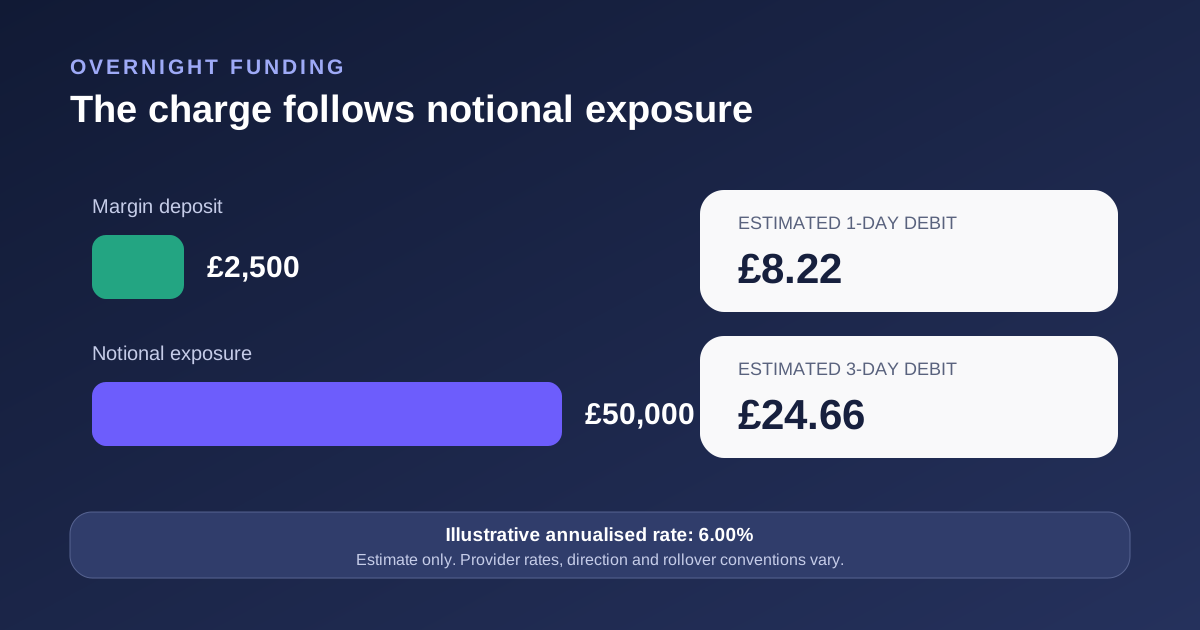
Leveraged CFD trading separates two numbers that traders often conflate: the margin deposit that secures the position and the notional exposure that the position controls. In the practices observed by the FCA, providers charged overnight funding on full consideration or notional exposure without an offset for account funds. A position opened with £2,500 of margin can control £50,000 of notional exposure, and if a debit rate applies to that full exposure, the daily charge reflects £50,000, not £2,500. Price movement is therefore not the only thing that can move the cash balance. [1]
This is also a disclosure issue that regulators have examined. In its multi-firm review of CFD providers published in November 2025, the FCA found that overnight funding can be a substantial ongoing cost for clients holding positions longer term, and it observed shortcomings in disclosures of how calculations are performed. The review noted charges applied to the full consideration or notional exposure without offset for account funds, the effect of leverage on costs relative to client funds, limited annualised equivalents, matched long and short positions charged separately, and a need to explain keeping positions open versus crystallising profit and loss. These findings describe disclosure weaknesses observed across reviewed firms; they are not a finding that every provider or every charge is unfair. [1]
The practical consequence is arithmetic, not opinion. If you only look at price charts, a market that closes where it opened looks free to hold. The cash ledger tells a different story once a daily adjustment posts at the rollover cut-off. Understanding how that adjustment is built, and being able to reproduce it line by line, is the purpose of this guide.
Definitions: the vocabulary of overnight charges
Provider labels vary, but the underlying concepts recur across platforms. The following definitions apply throughout this guide.
- Overnight funding: a daily interest-based fee or credit applied when a position is held past a stated cut-off time. IG UK describes it as a daily interest fee for its daily funded bets and cash CFD positions held through 10pm UK time. Pepperstone UK describes swap as a charge or credit for positions held past its 5pm New York server-time rollover. [2] [3] [4]
- Swap: another name for the same daily adjustment, common on forex platforms. The label differs; the mechanism is a rate applied to held positions at rollover. [4]
- Rollover: the process by which open positions are carried into the next trading day, typically involving a change of value date for settlement purposes and the posting of the funding adjustment. [4]
- Holding cost: a broader term some providers use for the same family of charges. CMC Markets UK uses 'holding costs' for its CFD overnight adjustments. [5]
- Tom-next: the tomorrow-next rate used to move a forex value date from tomorrow to the following business day. IG states that for forex and spot metals it uses the tom-next rate plus an admin component. CMC says its forex CFD holding rates are based on the underlying tom-next rate and expressed as an annual percentage. [2] [5]
- Benchmark rate: the reference rate underlying the calculation, such as tom-next for forex or a relevant interbank rate for shares and indices. For shares and ETFs, IG refers to the relevant benchmark, an admin fee and a possible short borrow charge. [2] [5]
- Provider markup or admin component: the element added to or subtracted from the benchmark by the provider. It may be disclosed separately or embedded in a single quoted rate. [2] [5]
- Borrow fee: a variable charge that can apply to short share positions. IG notes a possible short borrow charge for shares and ETFs and a borrow fee for short share positions. CMC notes a variable borrow-fee adjustment on short share trades. [2] [3] [5]
- Basis adjustment: for spot commodities constructed from futures, the daily movement of the spot price along the forward curve. IG constructs its described spot commodity price from the two nearest liquid futures contracts and posts the basis adjustment at 10pm UK time, with a separate admin component forming the charge. [6]
- Notional exposure: the full value of the position controlled, calculated from price multiplied by contracts or units. The FCA review found CFD overnight charges applied to full consideration or notional exposure without offset for account funds. [1]
- Margin: the deposit required to open and maintain the leveraged position. In the notional-based CFD charging observed by the FCA, account funds did not offset the full consideration used for the charge. [1]
- Debit and credit: the sign of the adjustment. A debit reduces your cash balance; a credit increases it. The sign depends on direction, the signed rate and the provider component.
- Rollover cut-off: the stated time after which a position counts as held for another day. Examples include 10pm UK time for the described IG UK products and 5pm New York server time for Pepperstone's described rollover. Cut-offs differ by provider and product. [2] [4]
- Value date: the settlement date attached to a position. Rollover advances the value date, and weekends and holidays create gaps that change how many days are charged. [4]
- Day-count divisor: the number used to convert an annualised rate into a daily amount. IG's dated market examples use 360 or 365 depending on currency and market. The applicable provider specification, not a default assumption, controls the reconciliation. [2]
- Account currency and conversion: the currency your ledger is denominated in. A rate may be quoted in the instrument or settlement currency and then converted, which introduces a conversion step into reconciliation.
Labels and formulas differ: what counts as primary evidence
The cited providers do not use one formula across every product. IG states that formulas and day-count conventions differ by market. Pepperstone shows current rates in its platform and warns that calculator estimates may differ from actual charges. CMC expresses its buy and sell calculations as adding or subtracting a CMC component on top of the underlying rate. Because conventions vary, three documents form the primary evidence for reconciling any charge: [2] [4] [5]
- The deal ticket or instrument specification captured before the cut-off, showing the applicable long and short rate, units and any stated formula.
- The provider's terms and product schedule in force for your account entity, which govern the cut-off time, day count and treatment of holidays.
- The posted ledger entry itself, with timestamp, currency and amount, which is the figure you are trying to explain.
If these three do not agree, check inputs, timing, rounding, conversion and separately posted components before asking the provider to explain any remaining difference. Document the result, particularly given the FCA's observations about disclosure quality. [1]
An indicative annualised-rate estimate, and its limits
For instruments where the provider quotes an annualised percentage rate, a generic estimate takes this form: the daily adjustment approximately equals notional exposure multiplied by the annualised rate, divided by the day-count divisor, multiplied by the number of charged days. Treat this as indicative only and subject to the provider's product conventions. [2] [5]
The limits matter as much as the formula. Rates can be signed differently for long and short sides. They can be expressed in points rather than percentages. They may already include the provider component, so adding an admin fee again would double count. Some instruments, such as the spot commodities described by IG, carry a basis adjustment that is not a simple interest calculation. Do not force every instrument into one formula; read the specification first. [6]
Worked example: one charged day versus three
The following figures are labelled hypothetical arithmetic using illustrative rates. They are not a quote, a prediction or any provider's current charge.
- Notional exposure: £50,000.
- Illustrative annualised debit rate: 6.00% per year.
- Day-count divisor: 365.
One charged day: £50,000 × 0.06 ÷ 365 = approximately £8.22. Three charged days: £8.22 × 3 = approximately £24.66. The margin deposit in this example is £2,500, but margin does not enter the calculation; the base remains the £50,000 notional. That gap between deposit and base is the leverage effect the FCA highlighted in its disclosure review. [1]
Reverse check: annualising a posted ledger entry
You can run the arithmetic backwards as a diagnostic. Suppose a £50,000 notional position receives a £9.59 one-day debit, with no currency conversion and no separately disclosed component. Dividing by the notional gives 9.59 ÷ 50,000 = 0.0001918 per day. Multiplying by 365 gives an implied simple annualised rate of about 7.00%.
Label this a diagnostic estimate, not proof of overcharging. The implied rate bundles together the benchmark, the provider component, any day-count convention and any rounding. A result that looks high against your expectation may reflect a legitimate convention difference, a points quotation you misread, or a component such as a borrow fee sitting inside the figure. Use it to frame questions to the provider, not as a conclusion.
Forex tom-next, value dates and the Wednesday roll
Forex funding follows settlement mechanics. For a T+2 pair, the value date is two business days after the trade date and advances when the position rolls. Pepperstone states that for its T+2 FX pairs the Wednesday-to-Thursday roll is normally three times the displayed daily amount, and that T+1 pairs use Thursday instead. IG applies a three-day adjustment to qualifying positions held through Wednesday 10pm UK time for its described forex and spot metals products. [2] [4]
The key point is that Pepperstone's tripled Wednesday swap advances the cited T+2 settlement across the weekend in a single posting; it is not three separate nightly postings. Holidays complicate this further: Pepperstone notes that holidays can create longer or zero-day rolls depending on valid settlement dates for both currencies in the pair. Do not assume a fixed weekday rule without confirming the convention for your specific provider, instrument and account entity. [4]
Long versus short: why shorts can pay too
It is tempting to assume longs always pay and shorts always receive, based on interest-rate differentials between currencies. A short position can receive a credit, receive less than expected, or pay a debit, depending on the signed rate for that side, the provider's bid or offer convention, the provider component and any borrow cost. CMC describes buy and sell calculations that add or subtract its own component on top of the underlying rate. [5]
Do not infer positive carry from central-bank rate differentials alone. The rate applied is the provider's signed, adjusted figure for the specific instrument and side, and the cited providers state that rates can vary. A credit does not make a losing directional trade profitable or safe; it offsets only part of the result. [4] [5]
Share borrow fees on short positions
A short share CFD or spread bet may carry a variable borrow cost linked to the underlying market. IG notes a possible short borrow charge for shares and ETFs and lists a borrow fee among short share position costs. CMC includes a variable borrow-fee adjustment in short share trades and says such fees can change as short interest rises. No specific borrow rate is quoted here; capture the actual figure from your specification and ledger. [2] [3] [5]
Cash CFDs versus dated forwards and futures
Some products show no separate overnight line item. IG states that its futures and forwards do not incur a separate overnight funding charge because financing is built into the spread. CMC says its forward contracts have fixed expiry or settlement dates and are not subject to separate holding costs. [3] [5]
Absence of a visible funding line does not mean absence of financing cost. The cost sits inside the spread or the contract pricing instead. Comparing a cash product with a dated product by looking only at the funding line will mislead you. Compare total entry cost, exit cost, spread behaviour, expiry or roll mechanics and funding over the same intended holding period. This guide does not recommend a contract type; the right choice depends on your intended hold, the instrument and the all-in numbers you calculate yourself. [3] [5]
Spot commodities: separating basis from fee
IG's described spot commodity prices are constructed from the two nearest liquid futures contracts. Its daily basis adjustment moves the spot price along the curve and is posted as a single adjustment at 10pm UK time. The separate admin component is the charge; the basis movement reflects the shape of the forward curve. [6]
Direction and curve shape determine whether the basis increases or decreases position value under the described IG mechanics. When reconciling that provider's commodity ledger entry, split the posted adjustment into the basis component and the admin component before drawing conclusions. Do not apply this construction to another provider or product without checking its specification. [6]
Matched long and short positions do not automatically net
Holding a long and a short in the same or related instruments may look offsetting, but overnight treatment may not net to zero. The FCA review highlighted matched long and short positions charged separately, meaning each leg can attract its own overnight treatment. Check both legs' specifications and ledger entries independently before assuming an offset. [1]
Currency conversion in the ledger
Funding rates may be quoted in the instrument currency or the settlement currency, while your ledger is denominated in your account currency. The final posted amount may therefore involve a conversion. Record both currencies involved, the conversion rate applied, the timestamp of the conversion, and any separately disclosed conversion cost. Do not assume a conversion fee exists or invent one; capture what the terms actually state. If the platform rate and the ledger disagree, an unrecorded conversion step is one of the first places to look.
A seven-line reconciliation method
The following workflow turns a confusing ledger entry into a reproducible calculation. Work through the lines in order and keep screenshots or exports of each input.
- Identify the exact entity and account. Terms, cut-offs and conventions can differ between entities and account types, so confirm which legal entity and product schedule governs your account.
- Record the symbol and product type. Cash CFD, spread bet, forward, future and spot commodity follow different conventions, sometimes within the same instrument name.
- Record direction, contracts and notional exposure at the cut-off. Note any partial closures or additions during the day, since the charged base is the position held through the cut-off, not the average of the day.
- Capture the long or short rate and its units. Screenshot the deal ticket or specification before the cut-off, noting whether the rate is a percentage, points, or already includes the provider component.
- Record the divisor, the number of charged days and the cut-off time with its timezone. Confirm whether tonight is a standard roll, a weekend-advancing roll or a holiday-affected roll.
- Calculate the expected adjustment using the specification's own formula where available, or the indicative formula where the rate is a clean annualised percentage.
- Compare against the posted ledger entry and isolate components. Split out any borrow fee, commodity basis adjustment and currency conversion until the residual difference is zero or explained.
Holding-cost scenario worksheet
The worksheet below uses a trader-entered rate and unchanged notional solely to show how debits accumulate over longer holds. Actual rates, prices, day counts, holidays and exposure can all change, so re-run the worksheet whenever any input moves.
Closing and reopening before rollover: not a free workaround
Closing before the cut-off and reopening later can avoid a nightly adjustment, but it can also add another spread, commission where applicable and execution slippage. The position is out of the market between trades, so price movement and gaps can change the result. Closing also realises the position result, while any tax or reporting effect depends on jurisdiction and product and is outside this guide. Compare the avoided funding entry with the added transaction costs and changed exposure. This is not advice to close, hold or cycle positions.
Audit failure modes: twelve ways reconciliations go wrong
- Using margin instead of notional exposure as the calculation base. [1]
- Applying the long rate to a short position, or vice versa. [2] [5]
- Treating a points quotation as a percentage, or the reverse. [2] [5]
- Using an annual rate directly without dividing by the day count. [2] [5]
- Assuming a 365 divisor where the provider specifies 360, or the reverse. [2]
- Missing a tripled or holiday-adjusted roll and expecting a single-day charge. [2] [4]
- Using the wrong cut-off timezone, for example conflating UK time with New York server time. [2] [4]
- Ignoring the position size held through the provider's cut-off. [2] [4]
- Omitting a separate borrow fee on a short share position. [2] [3] [5]
- Treating the described IG commodity basis adjustment as if it were pure interest, or omitting it entirely. [6]
- Ignoring currency conversion between the quoted rate and the account-currency ledger entry.
- Capturing the platform rate only after the rollover, when it may no longer match the rate applied to the earlier entry. [4]
A thirteenth failure mode deserves its own mention: comparing a dated forward or future to a cash product using only the visible funding line. The cited provider pages show that a dated product can omit a separate overnight entry while reflecting financing in spread or pricing, so compare total costs over the same holding period. [3] [5]
Evidence checklist for your records
Before treating any overnight charge as explained or unexplained, assemble the following. This checklist supports documentation and queries to your provider; it is not a recommendation to hold or close any trade.
- Screenshot of the deal ticket or instrument specification showing the long and short rate, taken before the cut-off.
- The governing terms and product schedule for your exact account entity, including cut-off time, timezone and day-count convention.
- Position record at the cut-off: direction, contracts, price and resulting notional exposure.
- Calendar note for the roll type: standard, weekend-advancing or holiday-affected, with the number of charged days expected.
- Your independent calculation with formula, divisor and result shown.
- The posted ledger entry with timestamp, currencies, conversion rate if applicable, and any disclosed conversion cost.
- Component breakdown: base rate, provider component, borrow fee, basis adjustment and conversion, each isolated where the specification allows.
- Any residual difference, quantified, with a note of whether it falls within plausible rounding and timing tolerance or warrants a query to the provider.
Overnight funding fields to capture
Capture each field before the cut-off where possible; post-cut-off values may already reflect the next period.
| Field | What to record | Common error |
|---|---|---|
| Account entity | Exact legal entity and product schedule governing the account | Assuming all account types share one set of terms |
| Symbol and product type | Instrument identifier plus cash CFD, spread bet, forward, future or spot commodity | Treating same-named instruments across product types as identical |
| Direction and size | Long or short, contracts or units, price at cut-off, resulting notional exposure | Using intraday average size instead of position held through cut-off |
| Rate and units | Long and short rate, percentage or points, whether provider component is included | Reading a points quote as a percentage |
| Divisor and charged days | Day-count divisor (for example 360 or 365) and number of charged days including roll effects | Missing weekend-advancing or holiday-affected rolls |
| Cut-off time | Stated cut-off with timezone, for example 10pm UK time or 5pm New York server time | Conflating timezones across providers |
| Components | Borrow fee, commodity basis adjustment, admin component, conversion rate and cost | Treating the whole posted entry as a single interest figure |
| Ledger entry | Posted amount, timestamp, currencies involved | Comparing against a rate captured after rollover |
Holding-cost scenario worksheet
Illustrative accumulation of debits at a trader-entered rate on unchanged notional. Not a quote or predicted charge; actual rates, prices, day counts, holidays and exposure can change.
| Charged days | Calculation | Estimated cumulative debit |
|---|---|---|
| 1 | £50,000 × 6.00% ÷ 365 × 1 | £8.22 |
| 3 | £50,000 × 6.00% ÷ 365 × 3 | £24.66 |
| 7 | £50,000 × 6.00% ÷ 365 × 7 | £57.53 |
| 30 | £50,000 × 6.00% ÷ 365 × 30 | £246.58 |
Sources
- Multi-firm review of CFD providers' provision of price and value — Financial Conduct Authority
- What is overnight funding, how is it charged and how is it calculated? — IG UK Help Centre
- What are the fees and costs of spread betting and CFD trading? — IG UK Help Centre
- Trading costs and fees — Pepperstone UK
- CFD holding costs explained — CMC Markets UK
- How are spot commodities priced, and how is my overnight funding calculated? — IG UK Help Centre
Frequently asked questions
- Is swap charged on margin or notional exposure?
- On the conventions described here, overnight funding is calculated on full notional exposure, not the smaller margin deposit. The FCA's November 2025 multi-firm review noted charges applied to full consideration or notional exposure without offset for account funds, and highlighted the effect of leverage on costs relative to client funds. A £2,500 margin deposit controlling £50,000 of notional would generate charges on the £50,000 base.
- Why is Wednesday's swap sometimes tripled?
- For T+2 forex pairs, settlement normally occurs two business days after trade date. Holding through Wednesday means the next value date would land on the weekend, so the roll advances settlement across Saturday and Sunday in one posting. Pepperstone states that for its T+2 FX pairs the Wednesday-to-Thursday roll is normally three times the displayed daily amount, and IG applies a three-day adjustment to qualifying positions held through Wednesday 10pm UK time. This is a value-date mechanic, not three consecutive nightly charges, and holidays can change the pattern.
- Can a short position still pay overnight funding?
- Yes. A short position can receive a credit, receive less than expected, or pay a debit depending on the signed rate for that side, the bid or offer derivation, the provider component and any borrow cost. CMC describes buy and sell calculations that add or subtract its own component separately. Positive carry should never be assumed from central-bank rate differentials alone.
- Are futures free of financing cost?
- No separate overnight funding line item does not by itself establish zero financing cost. IG states that its futures and forwards build financing into the spread. CMC says its forward contracts have fixed expiry or settlement dates and are not subject to separate holding costs. Compare total entry, exit, spread, expiry or roll and funding costs over the same intended holding period rather than judging by the visible funding line alone.
- Why does the platform rate not match my ledger?
- Common causes include using margin instead of notional, applying the wrong side's rate, misreading points as percentages, using the wrong day-count divisor, missing a tripled or holiday roll, using the wrong cut-off timezone, ignoring a changed position size, omitting a borrow fee or basis adjustment, overlooking currency conversion, or capturing the rate after the rollover when it has already updated. Rebuild the charge line by line using the deal ticket, the governing terms and the posted entry.
- Does closing before rollover always save money?
- No. Closing and reopening avoids the nightly adjustment but adds spread, possibly commission, slippage on both executions, lost market exposure and gap risk while flat, plus potential account and tax-reporting effects. Whether it saves money depends on the avoided charge versus the added total costs for your specific position and holding plan. Evaluate it as a total-cost comparison, not a default rule.
