Trading costs beyond the spread: reconstruct the full price of a trade
A minimum spread headline is not a cost record. The realised price of a trade combines entry and exit spreads, commission convention, slippage against the reference quote, overnight funding on notional exposure, borrow fees, currency conversion and conditional account charges. This guide defines each component, works through labelled hypothetical arithmetic and provides a ledger and comparison worksheet for a monthly audit.
Most retail traders first meet trading costs as a single number: the minimum spread a broker advertises. That number is a published floor, not a record of a completed trade. It does not establish what you will pay to open a position, hold it past a funding cut-off, convert currency, carry a short-share borrow component or close under different market conditions. Reconstructing full cost means separating components visible in quotes from adjustments recorded in the account statement.
This guide explains each component, shows how they combine in labelled hypothetical arithmetic, and provides two worksheets: a per-trade cost ledger and an account-comparison grid. Provider mechanics are cited as dated examples from IG UK, Pepperstone UK and CMC Markets UK, and regulatory findings come from the FCA's multi-firm review of CFD providers published on 13 November 2025. No provider is ranked and no fee figure from any provider is reproduced here. [1] [2] [4] [6]
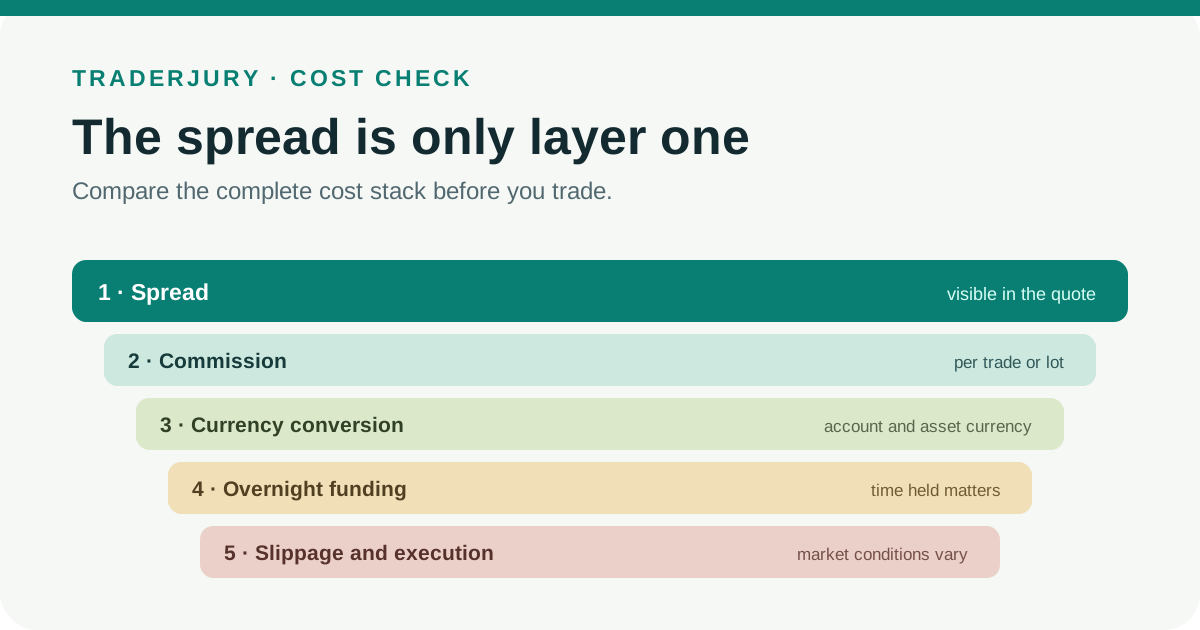
Quoted minimum versus realised all-in cost
The quoted minimum spread is the narrowest bid-ask difference a provider publishes for an instrument. Realised all-in cost is what the completed trade consumed: the entry and exit spread components, commission, the signed difference between reference prices and fills, funding posted for charged days, any borrow component, currency conversion and conditional platform, data, documentation or inactivity charges.
These can diverge. IG notes that FX CFD spreads are variable with underlying prices and can widen at illiquid times or around major news and data releases, and distinguishes explicitly between minimum and average spread figures. Trading in different sessions can therefore produce an average spread that differs from the published minimum, even on the same instrument and account. [3]
Core definitions
Price components
- Bid: the price at which you can sell. Ask (or offer): the price at which you can buy.
- Spread: the difference between ask and bid, usually expressed in points or pips. Pepperstone describes spread as the difference between bid and ask built into its trade prices. [5]
- Minimum spread: the lowest spread a provider publishes, typically observed in favourable conditions. Average spread: a provider-stated mean over a period, which better reflects typical conditions but still not your own fills. [3]
- Value per point: the account-currency amount gained or lost per point of price movement per unit of position size. It converts spread points and slippage points into money.
Execution and holding components
- Commission per side: a fee charged once on opening or once on closing. Round trip: a completed open-and-close cycle, which may attract commission twice unless the quote is stated round turn.
- Slippage: the difference between the reference price you intended to trade at and the price of your actual fill. It has a direction and a sign; adverse slippage increases cost, favourable slippage reduces it.
- Overnight funding (swap): a daily adjustment applied to positions held past a provider's cut-off time. Pepperstone applies an overnight adjustment after its stated rollover time; IG applies overnight funding on daily funded bets and cash CFDs held through 10pm UK time. [2] [5]
- Notional exposure: the full value of the position you control, distinct from the margin deposited as collateral. In the practices examined by the FCA, providers calculated overnight funding on full consideration or notional exposure without offset for account funds. [1]
- Borrow fee: a variable component that the cited providers say can apply to short share positions. Currency conversion: a charge or spread applied when an instrument or ledger amount is denominated in a currency other than the account currency. [2] [6]
- Dividend adjustment: a cash credit or debit applied to share CFD positions around dividend dates. Non-trading fee: conditional charges such as inactivity, documentation, market data or transfer fees. [2] [4]
Embedded costs versus posted costs
Some charges never appear as a separate line because they are inside the price. Spread is the clearest case: when you buy at the ask and could immediately sell only at the bid, the spread is a real economic cost even though no fee line appears. Pepperstone states that spread is built into its trade prices, and IG states the same for its spread betting and CFD products. [2] [5]
Other charges appear as explicit ledger entries: commission, overnight funding adjustments, borrow fees, dividend adjustments and conversion charges. The distinction matters for auditing. If a fee line is missing, the correct question is whether the cost is embedded elsewhere, not whether the cost is zero. IG notes that its futures and forwards have financing built into the spread rather than shown as a separate overnight line, and CMC makes the same point about forward contracts having no separate holding cost. [2] [6]
Calculating spread cost
For a symmetric quote, an indicative completed-trade spread estimate is one half of the entry spread plus one half of the exit spread, multiplied by money value per point. If both snapshots show the same spread, this reduces to spread points multiplied by value per point. Use the actual bid and ask snapshots at entry and exit, not a doubled published minimum. IG's product page shows why: its FX CFD spreads are variable and can widen at illiquid times or around major news or data. [3]
Worked hypothetical example
Every number below is illustrative arithmetic, not a provider quote. Assume a position worth £10 per point and symmetric bid-ask quotes with a 0.8-point spread at both entry and exit.
- The two half-spread components are 0.4 points at entry and 0.4 points at exit. Together, 0.8 points at £10 per point gives an £8 completed-trade spread estimate.
- Commission of £3 per side gives £6 for the round trip.
- Adverse entry slippage of 0.3 points costs £3; adverse exit slippage of 0.2 points costs £2; together £5.
- Pre-funding total: £8 + £6 + £5 = £19. Any overnight funding would be added on top, depending on nights held and direction.
Compare the £19 total with a hypothetical 0.4-point minimum headline. Multiplying that floor by £10 per point produces a £4 headline-derived spread figure, while the actual 0.8-point entry and exit snapshots produce the £8 spread estimate used here. Commission and slippage bring the labelled pre-funding total to £19. The example shows why a ledger uses observed inputs instead of a published floor.
Why a minimum spread cannot predict realised cost
A minimum such as 'from 0.0' carries no information about duration, frequency, size, liquidity window or your realised average. It is a floor observed under specific conditions. IG's product details distinguish minimum from average spread precisely because FX CFD spreads vary with underlying prices and widen at illiquid times or around major data. Your realised average depends on when you trade, how long you hold and how large your orders are relative to available liquidity. [3]
Spreads can also vary by instrument, time and trade size within a single provider. IG states that spreads on its described products can vary by market conditions, time, instrument and size. Two traders on the same account type can therefore record very different average spreads purely through session choice. [2]
Standard accounts versus raw spread plus commission
Pepperstone describes two account structures: a spread-only model and a raw-spread-plus-commission model. In the second, the spread component is narrower and a separate commission is charged. Neither structure is inherently cheaper. Whether raw plus commission beats spread-only depends on the realised spread you actually receive, the commission convention, your trade size and your trade frequency. [4] [5]
Holding other cost categories constant, a raw-spread-plus-commission structure has a lower direct spread-and-commission total only when the observed spread saving exceeds its commission. Both inputs are empirical, so calculate the difference from matched statements at the same size and session rather than infer it from advertising.
Normalising commission notation
Commission is quoted in three common conventions: per side (charged on opening and again on closing), round turn (a single charge covering the complete trade) and per lot (scaled by contract size). Comparing a per-side quote against a round-turn quote without halving or doubling produces errors of exactly a factor of two.
Before comparing anything, normalise each quote into account currency per completed trade at the actual position size. Multiply a per-lot figure by lot count. For per-side pricing, add the opening and closing charges, accounting for any minimum or tier that changes either side. Apply a percentage-based charge to the value defined in the provider's terms. Only then place the totals side by side.
Slippage as a separate cost category
Slippage is not spread and should be measured separately. To quantify it you need four items: the reference quote you intended to trade at, the signed direction of the difference, the execution timestamp and the actual fill price. For a long position, adverse entry slippage means buying above the reference ask and adverse exit slippage means selling below the reference bid. For a short position, adverse entry slippage means selling below the reference bid and adverse exit slippage means buying above the reference ask.
A price difference alone does not establish broker misconduct. Market movement, gaps, latency, order type, available liquidity and the chosen reference timestamp can contribute to a difference between a seen price and the fill. Record the evidence across many trades before asking the provider to reconcile a pattern; do not assign a cause from one fill.
Overnight funding on notional exposure
In the CFD practices examined by the FCA, providers calculated overnight funding on full consideration or notional exposure without offset for account funds. The FCA's review, published on 13 November 2025, found that overnight funding can be a substantial ongoing cost for clients holding CFDs longer term and described leverage effects that make cost large relative to client funds. It also identified disclosure shortcomings involving annualised equivalents and matched long and short positions charged separately. [1]
Two practical consequences follow. First, a small margin deposit does not cap the funding cost, because the base is the full position value. Second, matched long and short positions may each attract treatment rather than netting to zero, so hedged books need checking line by line. Detailed formulas, benchmark components and rollover cut-offs are covered in TraderJury's separate overnight-funding guide; this article treats funding as one line in the all-in cost picture. [1]
Provider mechanics illustrate the variety. Pepperstone applies an overnight adjustment after its stated rollover time on spot trading. IG applies overnight funding on daily funded bets and cash CFDs held through 10pm UK time. CMC uses tom-next rates for its forex CFDs and describes product-specific holding formulas with benchmark and provider components. These are dated provider examples, not industry-wide rules. [2] [4] [6]
Conditional line items
Several further charges apply only under stated conditions, and each should be treated as a possible ledger line rather than assumed present or absent.
- Borrow fees: short share positions may incur a borrow fee where the underlying stock must be borrowed. CMC describes a possible variable borrow adjustment for short shares. [2] [6]
- Currency conversion: instruments priced in a currency other than your account currency may attract conversion charges. IG lists currency conversion among charges that can apply under stated conditions. [2]
- Market data, charting and documentation: IG notes these can also apply under stated conditions, and Pepperstone lists conditional non-trading charges. [2] [4]
- Dividend adjustments: Pepperstone describes dividend cash adjustments on share CFDs, applied as credits or debits around ex-dividend dates. [4]
Futures and forwards: when there is no separate funding line
If your product shows no separate overnight funding line, the financing may be incorporated into the spread or contract pricing. IG states that futures and forwards have financing built into the spread rather than a separate overnight line, and CMC states that its forward contracts carry no separate holding cost. Pepperstone likewise notes no separate overnight funding on its forwards. [2] [4] [6]
The absence of a separate line does not establish that a dated contract is cheaper overall. For the cited providers, financing is reflected in spread or contract pricing. Compare the observed entry and exit prices, expiry or roll treatment and other charges with the spot spread and posted funding over the same intended horizon.
Worksheet 1: the all-in cost ledger
Build one row per completed trade. Every field comes from your export history or statement, not from memory.
- Record entry timestamp, direction (long or short), size and the bid/ask you saw at order submission.
- Record the reference price used by the platform and your actual fill price; compute signed slippage in points and in account currency.
- Record exit timestamp, exit bid/ask, reference price, fill and signed exit slippage.
- Record commission charged, noting whether it appeared once or twice and converting to account currency per completed trade.
- Record every overnight funding adjustment with its date and sign, plus any borrow fee for short share positions.
- Record currency conversion amounts, dividend adjustments and any platform, data, inactivity or documentation charge allocated to the period.
- Sum the categories into a per-trade all-in cost, and divide by notional exposure to express cost per unit of notional.
Worksheet 2: like-for-like account comparison
Comparing two account types fairly requires holding everything constant except the account. Use the same instrument, the same size, the same holding period, the same session and the same order type. Then distinguish three kinds of number: advertised values from marketing pages, observed values from live fills, and posted values from the ledger.
Advertised minimums belong in a separate column from your measured averages, and neither should be mixed with posted funding and commission totals. If the two accounts show different average spreads on identical trades, the difference is real and belongs in the comparison. If they show identical spreads but different commission conventions, normalise both to account currency per completed trade before concluding anything.
Three scenarios showing how dominant costs shift
All numbers below are labelled hypothetical illustrations, not provider quotes. Each scenario uses £10 per point and the same illustrative rates as the earlier worked example.
Scenario A: one intraday trade
Assume the position opens and closes before the provider's funding cut-off, with no holding adjustment posted. The £8 completed-trade spread estimate, £6 round-trip commission and £5 slippage total £19. In this labelled example, only the transaction-related categories are present.
Scenario B: one seven-night position
Keep the same £19 pre-funding arithmetic, then assume the ledger records seven charged days. Add the actual signed funding entries to the ledger rather than inventing a rate. The FCA found that overnight funding can be a substantial ongoing cost for longer-held CFDs, but whether it dominates this particular trade can be known only after the applicable notional, rate convention and charged days are recorded. [1]
Scenario C: twenty small round trips
Twenty round trips at the same per-trade economics produce £380 pre-funding (£160 spread, £120 commission, £100 slippage). At unchanged per-trade economics, frequency multiplies each transaction-cost category proportionally and leaves its percentage share unchanged. Comparing account structures still requires the observed spread saving to be weighed against the additional commission.
No scenario is declared best. The mix of costs depends on holding duration and the pricing structure. Increasing frequency alone scales unchanged per-trade costs proportionally; a single headline cannot describe all trading patterns.
Monthly audit procedure
- Export your full trade history and account ledger for the month, including adjustments and non-trading charges.
- Match each ledger entry to a trade ID; flag unmatched adjustments for investigation with the provider.
- Normalise all amounts into your account currency, noting conversion charges themselves as a cost category.
- Separate costs into categories: spread, commission, slippage, funding, borrow, conversion, dividends and non-trading charges.
- Calculate cost per completed trade and cost per unit of notional exposure for each category and in total.
- Archive the exports, worksheets and methodology notes, and date the result so future months are comparable.
All-in trading cost ledger
One row per completed trade. Populate from exported history and ledger, not from memory. All columns are TraderJury worksheet fields with no source-specific values.
| Field | Where to find it | Cost category | Notes |
|---|---|---|---|
| Entry timestamp | Trade history export | Context | Sets the liquidity window and funding start |
| Direction | Trade history | Context | Long or short; affects funding sign and borrow eligibility |
| Size | Trade history | Context | Determines value per point and notional exposure |
| Bid/ask seen | Platform screenshot or history | Reference | Pre-execution quote at submission |
| Reference price | Statement or confirmation | Reference | Baseline for slippage measurement |
| Fill price | Statement | Spread and slippage | Actual executed price |
| Exit timestamp, bid/ask, reference, fill | Trade history and statement | Spread and slippage | Completes the round-trip spread calculation |
| Commission | Ledger | Commission | Check per side versus round turn; normalise to account currency |
| Overnight funding entries | Ledger | Funding | One line per posted adjustment or charged period, with date and sign |
| Borrow fee | Ledger | Borrow | Short share positions only, where applicable |
| Currency conversion | Ledger | Conversion | Instruments denominated outside account currency |
| Dividend adjustment | Ledger | Cash adjustment | Share CFDs around ex-dividend dates |
| Platform, data, inactivity, documentation | Account statements | Non-trading | Allocate to the period, not to individual trades |
| Total per trade and per notional | Calculated | Summary | Sum categories; divide by notional exposure |
Like-for-like account comparison
Complete one column per account using identical instrument, size, holding period, session and order type. Keep advertised, observed and posted values in separate rows.
| Row | Account A | Account B | Type of value |
|---|---|---|---|
| Instrument, size, session, order type | Control variables (must match) | ||
| Advertised minimum spread | Advertised | ||
| Provider-stated average spread | Advertised | ||
| Measured average entry spread | Observed | ||
| Measured average exit spread | Observed | ||
| Commission convention and amount per completed trade | Posted (normalised) | ||
| Total funding over holding period | Posted | ||
| Borrow fees | Posted | ||
| Conversion charges | Posted | ||
| Measured slippage, entry and exit | Observed | ||
| Non-trading charges allocated | Posted | ||
| All-in cost per trade and per notional | Calculated |
Sources
- Multi-firm review of CFD providers' provision of price and value — Financial Conduct Authority
- What are the fees and costs of spread betting and CFD trading? — IG UK Help Centre
- Forex CFD product details — IG UK Help Centre
- Trading costs and fees — Pepperstone UK
- How does Pepperstone make money? — Pepperstone UK
- CFD holding costs explained — CMC Markets UK
Frequently asked questions
- Is a zero spread trade free?
- No. Zero spread removes one cost component only. Commission, slippage, overnight funding on notional exposure, borrow fees, currency conversion and conditional account charges can all still apply. Some products also embed financing in the price rather than posting a separate funding line, so a missing fee line does not prove zero economic cost.
- Should I use minimum or average spread?
- A provider-stated average contains more information than a minimum floor, but neither is your realised record. IG says its FX CFD spreads are variable and can widen at illiquid times or around major news and data. For auditing, measure entry and exit quotes from your own matched fills.
- Is commission charged once or twice?
- It depends on the convention. A per-side quote applies to one side, so a completed trade normally includes an opening and a closing amount, though posting time can differ. A round-turn quote covers the complete trade. Per-lot quotes scale with size. Check minimums and tiers, then normalise the posted total into account currency.
- Does slippage count as a fee?
- Slippage is not a billed fee. It is the signed difference between a defined reference price and the actual fill: adverse slippage raises realised cost, while favourable slippage reduces it. Record the quote, side, timestamp, order type and fill separately from spread. A difference alone does not establish its cause or misconduct.
- Are forwards free of financing cost?
- A missing overnight line does not establish zero financing cost. IG and Pepperstone say financing for their cited futures or forwards is built into spread or pricing, while CMC says its forwards have no separate holding cost. Compare observed prices, expiry or roll treatment and other charges with spot spread plus posted funding over the same horizon.
- How do I compare two account types fairly?
- Hold the instrument, size, holding period, session and order type identical across both accounts. Distinguish advertised values from observed fills and posted ledger entries. Normalise commission conventions to account currency per completed trade, then compare measured average spreads, commission, funding and slippage. Neither a spread-only nor a raw-spread-plus-commission structure is inherently cheaper; the break-even depends on your realised spread, trade size and frequency.
